Purpose: The purpose of this blog post is to demonstrate how to read a csv file in X++ Product: Dynamics AX 2012 Code: static void MAKReadFile(Args _args) { #File IO io; CustAccount custAccount; Email email; FilenameOpen filename = @"C:\Temp\CustomerContactInfo.csv"; Container record; ; io = new CommaTextIo(filename, #IO_Read); if (!io || io.status() != IO_Status::Ok) { throw... Continue Reading →
Create contact information in X++
Purpose: The purpose of this blog post is to demonstrate how to create contact information in X++ Product: Dynamics AX 2012 Description: The code create contact information with purpose "Collection" on the customer record. Code: static void MAKCustContactCreate(Args _args) { #define.LocationRoleName('Collection') CustTable custTable; DirPartyTable dirPartyTable; LogisticsElectronicAddress logisticsElectronicAddress; LogisticsLocationRole locationRole; Map locationRoleMap; container locationRoleCon; ; custTable... Continue Reading →
Create print management settings in X++
Purpose: The purpose of this blog post is to demonstrate how can we create print management settings in X++ Product: Dynamics AX 2012 Description: The code creates a print management settings record on a customer for collection letter note document and uses first contact of type email and purpose "Collection" found on the customer record... Continue Reading →
AX 2012: Existing DIXF service for new AOS instance
Product: Dynamics AX 2012 Purpose: The purpose of this document is to explain what we can do to reuse a DIXF service of an existing AOS instance for a new AOS instance Steps: Copy paste the following files from the bin folder of an existing AOS instance to the bin folder of the new AOS... Continue Reading →
AX 2012: Create SSRS Line Chart Report
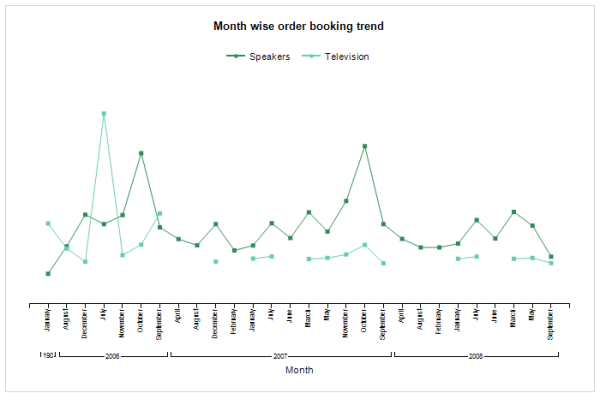
Purpose: The purpose of this document is to demonstrate how we can leverage the power of business intelligence through a simple SSRS line chart report. Prerequisites: Visual Studio 2013 Visual Studio 2013 tools. Reporting extension. Report Builder. Should be well-versed in Report Programming Model. Business requirement: Leverage business intelligence by analyzing sales trends for top item groups... Continue Reading →
AX 2012: Understanding postal addresses data model

Purpose: The purpose of this document is to quickly understand the underlying data model which is used by Dynamics AX to store postal addresses for a party. Some examples of party are customer, vendor and company. Assumptions: Basic understanding of UML's crow foot notation for data modeling. Data model:
AX 2012: Create AIF document service
Purpose: The purpose of this document is to illustrate how we can develop AIF document service, what are the important methods available that can be overridden to do the customization and finally how we can consume/unit test the document service through an external .NET application. Business requirement: Ability to integrate Dynamics AX with external systems.... Continue Reading →
AX 2012: Create AIF custom service
Purpose: The purpose of this document is to illustrate how we can develop AIF custom service. Business requirement: Ability to integrate Dynamics AX with external systems. Assumptions: Application Integration Framework has been configured to process inbound and outbound messages. Development: Create a data contract class. Use [DataContractAttribute('Name')] attribute to indicate class represents data contract. Use [DataMemberAttribute('Name')]... Continue Reading →
AX 2012: Add custom field to standard DIXF target entity

Purpose: The purpose of this document is to describe how we can add custom fields to standard DIXF target entity. While performing data migration for standard entities like customer, we often come across a requirement to load data for customized fields as well. In this post, we will add custom fields of customer master to its standard... Continue Reading →
AX 2012: Open fiscal periods in X++
Purpose: The purpose of this document is to describe how we can quickly open fiscal periods through X++. Development: // Developed on 28 Dec 2015 by Muhammad Anas Khan // Blog: dynamicsaxinsight.wordpress.com // LinkedIn: pk.linkedin.com/in/muhammadanaskhan // Description: Ability to confirm purchase order static void MAKOpenFiscalPeriods(Args _args) { FiscalCalendarPeriod fiscalCalendarPeriod; LedgerFiscalCalendarPeriod ledgerFiscalCalendarPeriod; ttsBegin; //Open fiscal periods... Continue Reading →
 D365 for Finance and Operations